Overview: Best DAW Software for Windows: Digital Audio Workstations Compared
Learn when a fast waveform editor and built-in multitrack mixer is faster and simpler than a complex commercial DAW.
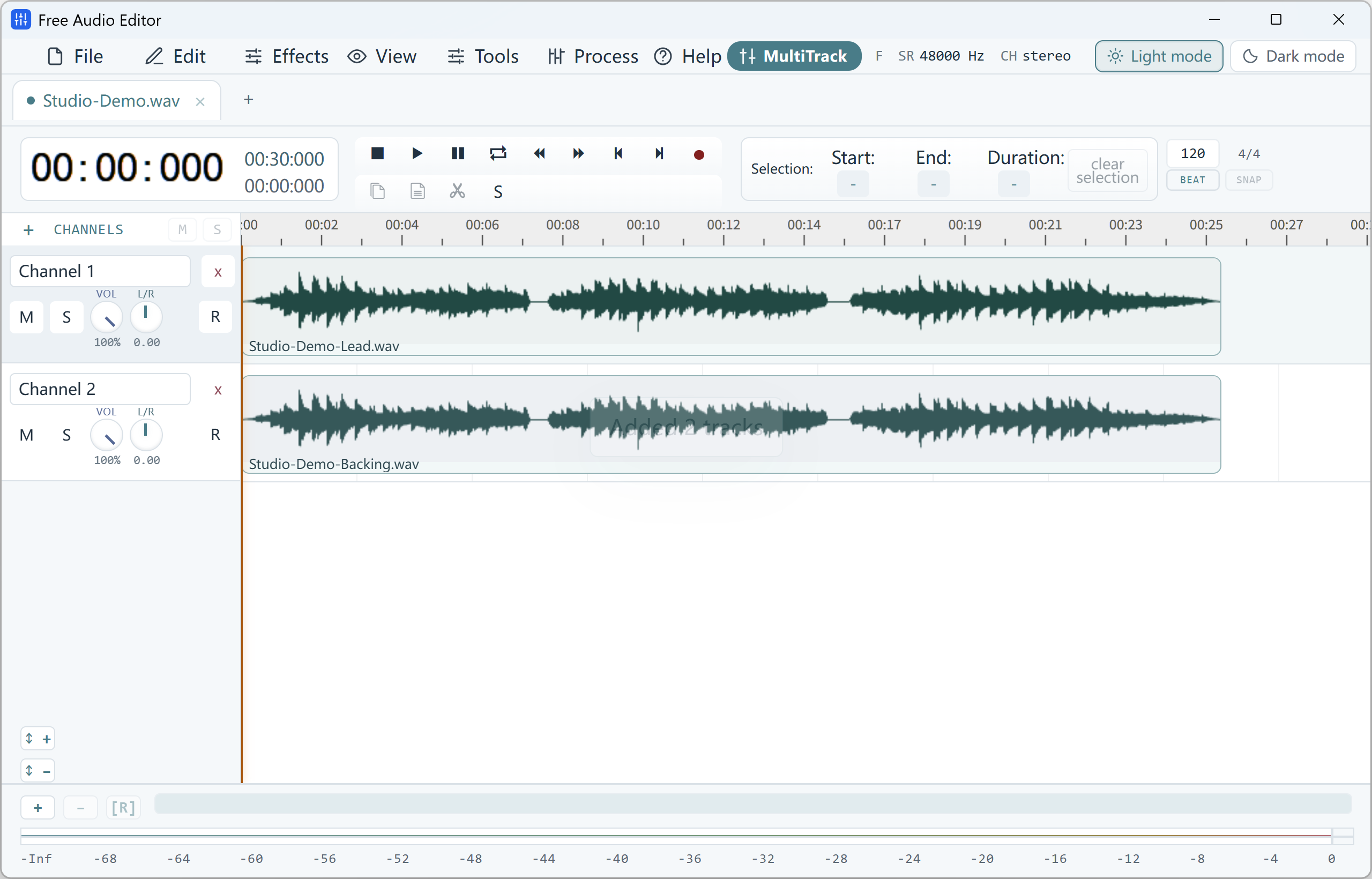
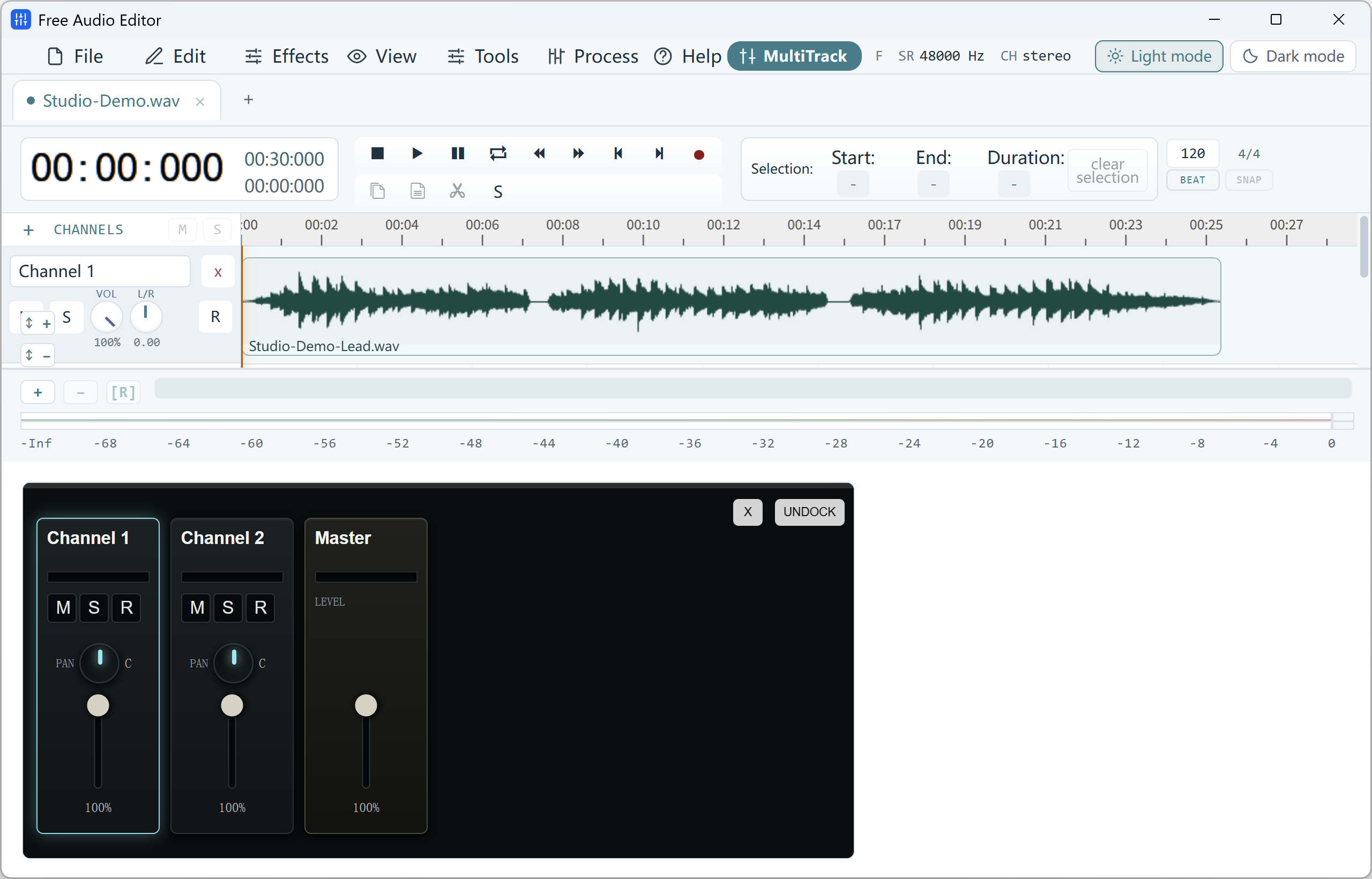
With Free Audio Editor, you get a complete stereo waveform and spectrogram editor, native microphone + WASAPI system loopback recorder, 5-stage Repair Studio, Podcast Chain, and Multitrack Mixer on Windows 11 and Windows 10. Audio editing, project saving (.wsmith), and WAV export are free without registration; registration unlocks MP3, FLAC, AAC, and 58 export definitions.
More Details & Tips
Home recording was first launched in 1990’s and that’s when the earliest versions of the current DAW began. Ever since, people have never been so sure which one of the many Digital Audio Workstations works best. If you are just a beginner trying to figure out the best DAW software to buy, this article is designed for you. It is about the best DAW software for Windows 2018 and the one we like the most tops this list.
Another point to keep in mind is that some options out there are free of charge and others are paid for. Thus, we would advise you to pick your DAW for 2018 based mostly on quality even if it’s free. So, here we go:
1. Free Audio Editor (Best Free Option for Recording & Editing)
Free Audio Editor is not a full music-production DAW, but for recording and editing it covers what most people need — free. It records your microphone, the sound playing on your PC, or both at once, and opens every take on a clear waveform with a spectrogram, Repair Studio for clicks, hum and breaths, and a Multitrack Mixer for combining voice and music.
How to Record and Edit Audio with Free Audio Editor
Step 1: Open the recorder
Launch Free Audio Editor and open Tools > Record. Choose your microphone, your Windows playback device, or enable the second source to record both together.
Step 2: Choose the layout and sample rate
Pick a combined stereo mix or keep the two sources on separate left/right channels, and choose a sample rate up to 96 kHz. Watch the live level meter so the signal never clips.
Step 3: Record and stop
Start recording, play or speak, then stop. The finished take opens directly on the waveform. Made a mistake? Use Punch-In recording from the playhead to replace just that part.
Step 4: Edit and clean up
Select a region on the waveform to cut, copy, paste or delete it. Use Effects for EQ, compression and reverb, and Process > Repair Studio to remove clicks, hum and breaths.
Step 5: Save
Save the session as a project, or export WAV for free. Registration unlocks MP3, FLAC, AAC and other export formats.
2. Presonus Studio One 3
Presonus DAW line is quite young, although the company itself is famous for creating the best quality and affordable hardware. In alliance with many developers from Steinberg Cubase, Presonus came up with its first version of Studio about eight years ago. You have three options: Studio One Prime (free for downloading), Studio One Artist and Studio One Professional. Note that Studio One Artist can be yours for free if you pick these 3 interfaces: PreSonus Audio Box USB, Presonus AudioBox 22VSL and Presonus Audiobox 44VSL.
3. FL Studio
First, FL Studio was called Fruity Loops. This changed when an Image-Line was developed and officially altered the former name of the software. This DAW is famous because of showing a spreadsheet-like playlist, a flexible piano roll and extensive automation capabilities. Among all DAWs, this is the only one that will offer you free lifetime updates. You can opt to buy Fruity, Producer or Signature bundle based on your ability to pay for them. Your Fruity Edition lacks an audio recording, so you might want to leave it out unless you only make electronic tunes. There is now an FL studio Mobile that is cool for a mobile user.
4. Ableton Live
This one was first designed as an instrument for live performers. It has ever since evolved into a total recording package that includes a visual interface that fits well on a single laptop screen. The most popular products include Ableton Push 2(w/Live 9 Intro), Novation Launchpad and Akai Professional APC Mini. These are third-party hardware controllers made for the software. Do you need a live performance tool, select the company’s live versions like: Ableton Live 9 INTRO, Ableton Live 9 STANDARD or Ableton Live 9 SUITE.
5. Steinberg Cubase
The earliest version of Cubase got launched in 1989 and it was a MIDI edition. But in 1992, the company came up with two big software advancements. It added support for audio and Windows compatibility. Ever since, the company has continued to enhance its technology and has therefore made huge advancements to the music sector itself. Up until now, Cubase has managed to keep its relevance for the decades it has been around. Steinberg Cubase Elements 9, Steinberg Cubase Pro 9 and Steinberg Cubase Artist 9 are the available versions for you.
6. Propellerhead Reason
This is not your average DAW as it provides a great feature you will easily miss in a competitor product. As well as being a standalone digital audio workstation, Propellerhead Reason acts as a group of virtual instruments that you could use together with other types of DAW. It has a nice interface that mimics the design of a real studio rack, permitting a rear access for cable patching. Pick this item if you love virtual instruments. Available picks are Reason9 Essentials and Reason9 full.
7. Avid Pro Tools
Currently, Avid Pro Tools is one of the most popular companies. It leads in the field of music recording and everyone uses it, explaining why pro studios, home studios and other entities use it. While Pro Tools has haters and is not great for everybody, you can pick it if this is your first DAW tool. It is desirable for beginners who don’t know what to use first and it is available in three versions: Pro Tools First, Pro Tools 12 and Pro Tools HD 12. The beginner version is the Pro Tools First and it is free of charge and downloadable. So you have nothing to lose by trying it. Pro Tools 12 is proper for intermediate users while Pro Tools HD12 is designed for professionals. It is a part of an HD Core System.
8. Cockos Reaper
Reaper or Rapid Environment for Audio Prototyping and Efficient Recording is the brainchild of Cockos Incorporated. Reaper is special because it managed to become so popular without creating a big advertising budget. Through enthusiastic users who liked its product, Reaper became really famous. Besides its so regular update releases, Reaper has a great price structure. Now they offer a downloadable free version of their software for 2 months after which you should buy a license for sixty dollars. You can get a more expensive (225 dollars) commercial license too for business use. Compared to most DAW listed above, Reaper is way cheaper.
Now that you know the best DAW software for windows 2018, it’s up to you to pick the one you like the most according to your related experience.